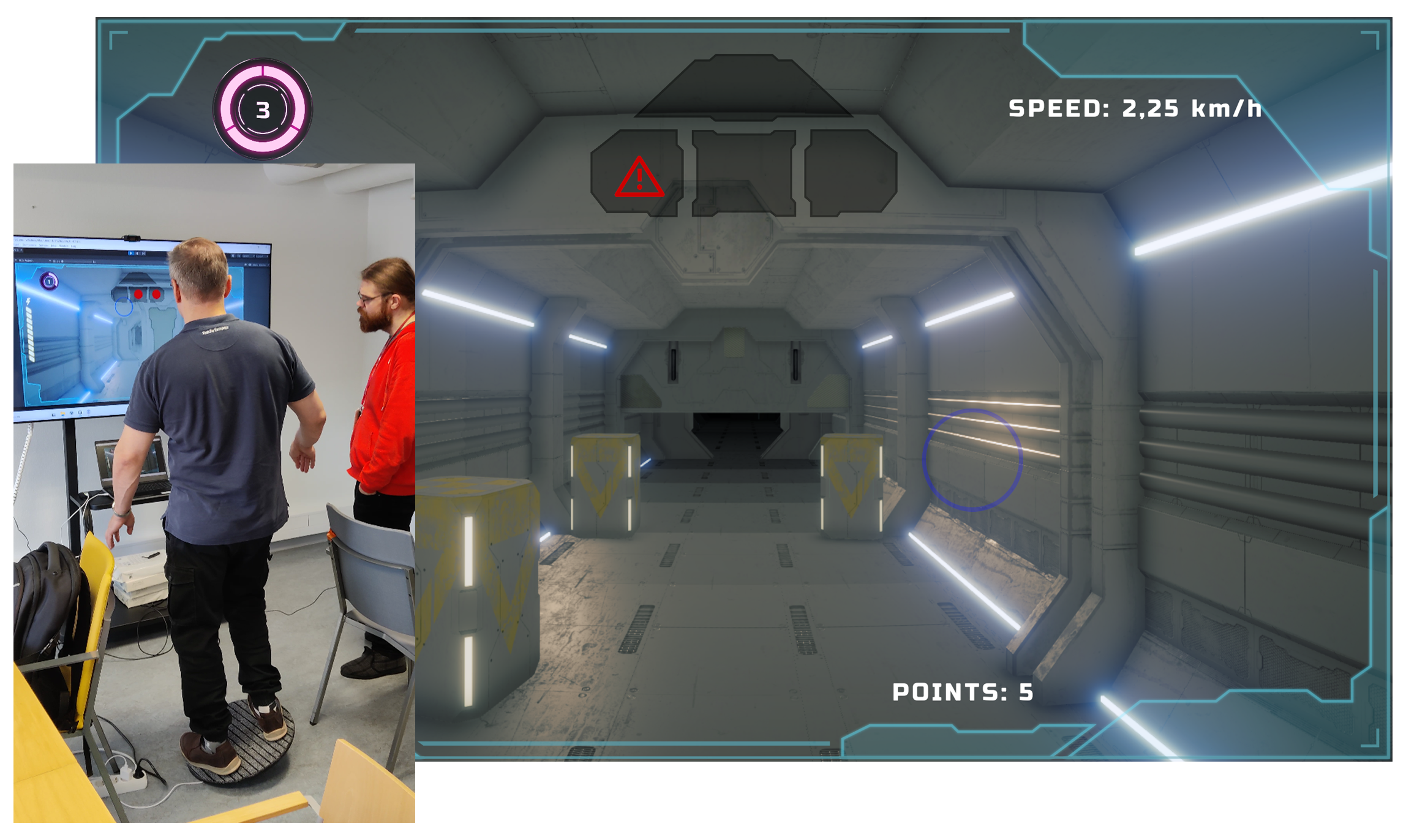
In the spring, the team from Lapland UAS’s FrostBit software laboratory and experts from the sports instructor training program joined forces at the Sports Lab to develop a new gamified solution for perceptual-motor training.
As we explored the operating environment’s characteristics and potential uses, our first challenge was using the Motek Grail system in the context of an external game implementation. We could not extract data from the system, nor could we access the Vicon motion capture system as a standalone component. The system is closed for good reason—due to factors such as safety and licensing. Unfortunately, we could not proceed with adapting the system within the Sports Lab for the MOCAPPE project; instead, we set out to find a new solution for motion capture and perceptual-motor training.
Using the Sports Lab’s existing equipment and systems is currently not entirely effortless or agile for just anyone; utilizing the space always requires the presence of a technical expert. Therefore, for Work Package 1 (Sports Games), we decided to make the implementation as lightweight and portable as possible, ensuring that setting it up would be easier than calibrating a large-scale system. The plan for the game’s functionality began as follows (picture in Finnish):
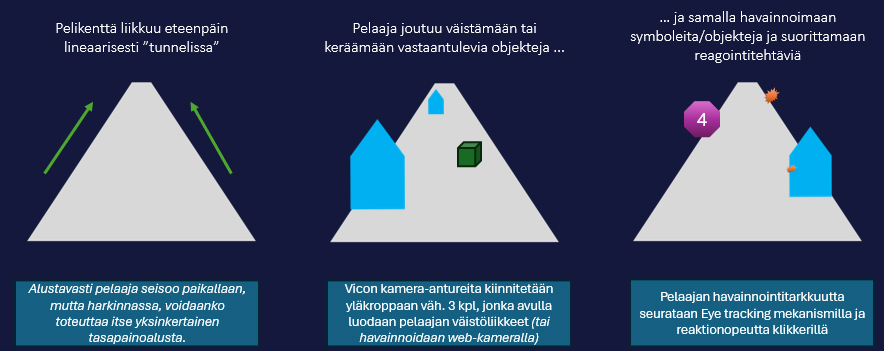
A simple tunnel environment designed as an endless runner game was chosen for several reasons:
-
- The specifications of the computer used in the Sports Lab cannot handle the heavy load imposed by a complex game engine; therefore, the environment had to be simple (the more detail it contains, the more demanding it is on the computer’s processing power).
- The endless runner genre allows for a level that progressively increases in difficulty and inevitably comes to an end. This simplifies the calculation and measurement of performance compared to designing distinct difficulty levels across multiple stages.
- A tunnel-like environment facilitates game elements characteristic of a game designed to test or train perceptual-motor skills.
-
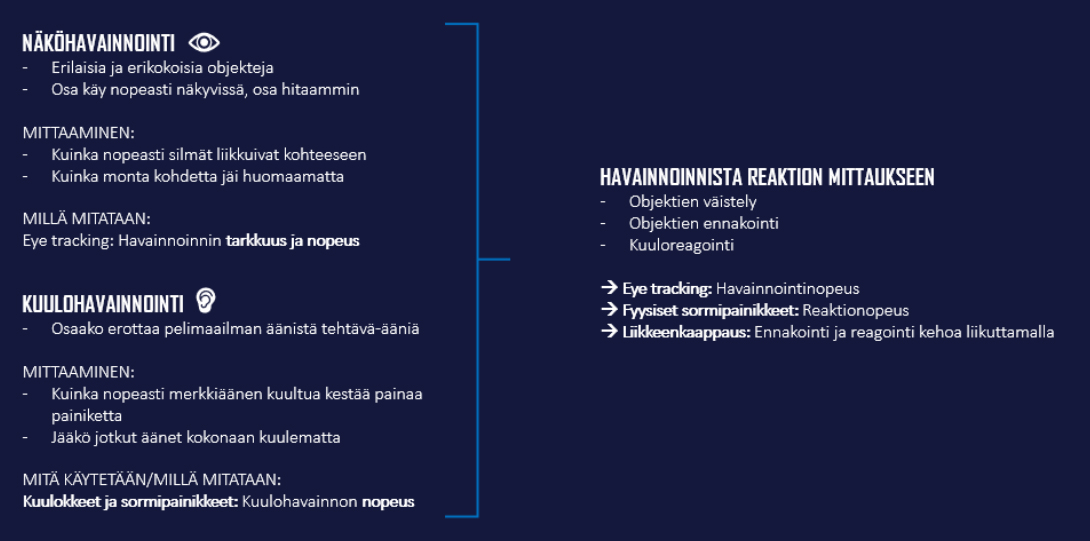
- Eye tracking and motion capture were implemented using Beam Eye Tracker software (a webcam-based solution). A balance platform was developed to serve as an alternative body-movement controller (or, optionally, simply to introduce balance challenges).
- Wireless headphones enable auditory perception tasks.
- Wireless controllers for the left and right hands measure reaction speed; these controllers utilize Arduino Nano ESP32 microcontrollers that communicate with each other via ESP-NOW and transmit data to the computer via BLE.
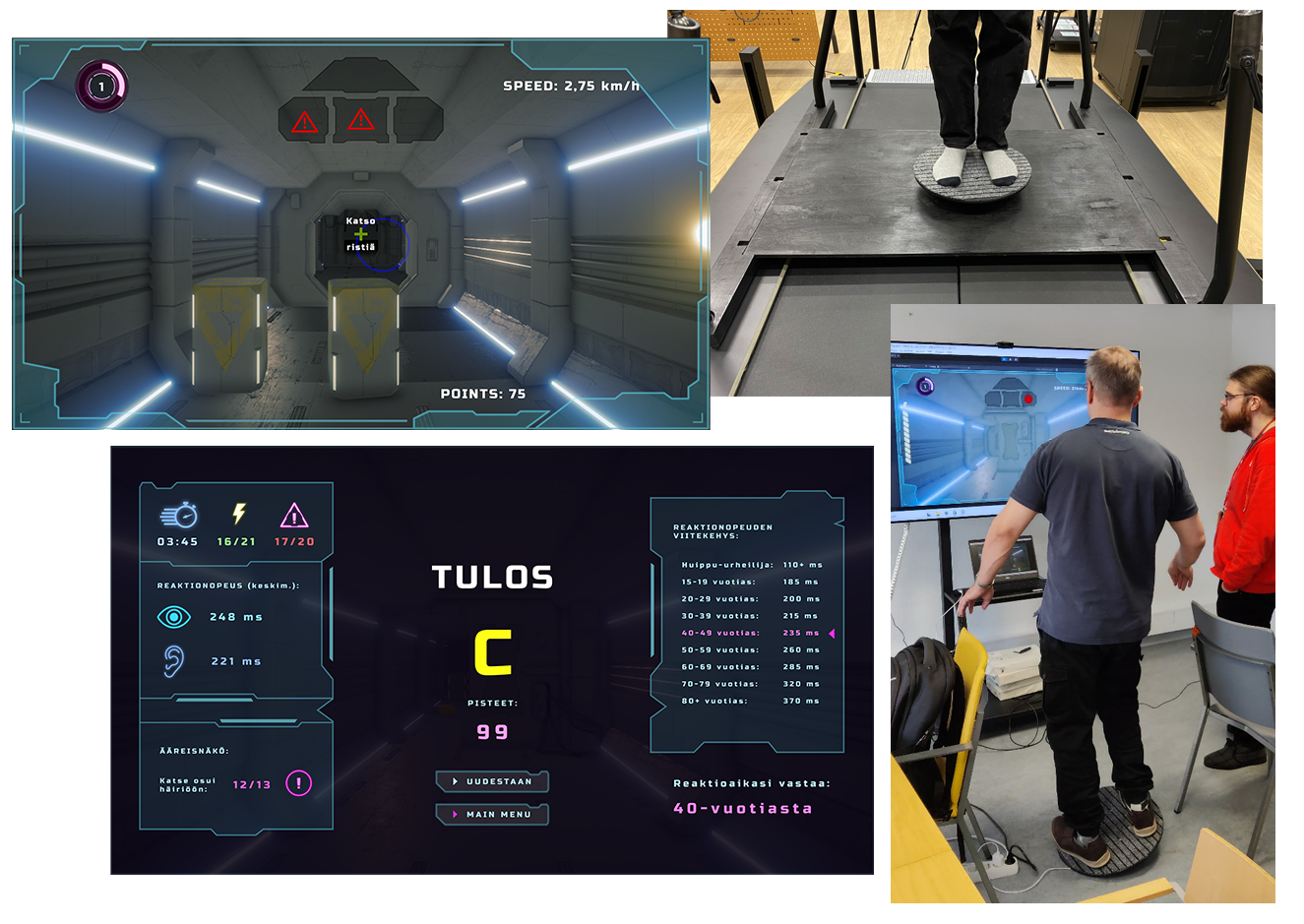
In this perceptual-motor game, the player moves using their own body. Beam tracks head position via eye-tracking, allowing the player to dodge left, right, and downwards. Movement to the left and right is also possible using a balance board, though movement with the board is more challenging and sensitive.
During the game, the player dodges, observes, collects items, and reacts to various objects and stimuli. Anticipation, reaction speed, peripheral visual awareness, and decision-making are assessed based on performance, with the player receiving both immediate feedback and final results after the game ends.
As of autumn 2026, we have already tested a more advanced demo with several groups, and we are planning a separate testing workshop at the Sports Lab—the game’s actual operational environment. Stay tuned later this year to see where we end up with the game!